Partners & Collaborations
HDC works with specialized partners from industry and research on the development and implementation of resilient energy systems.
We combine expertise across the entire energy ecosystem, from research and development to system integration and manufacturing.
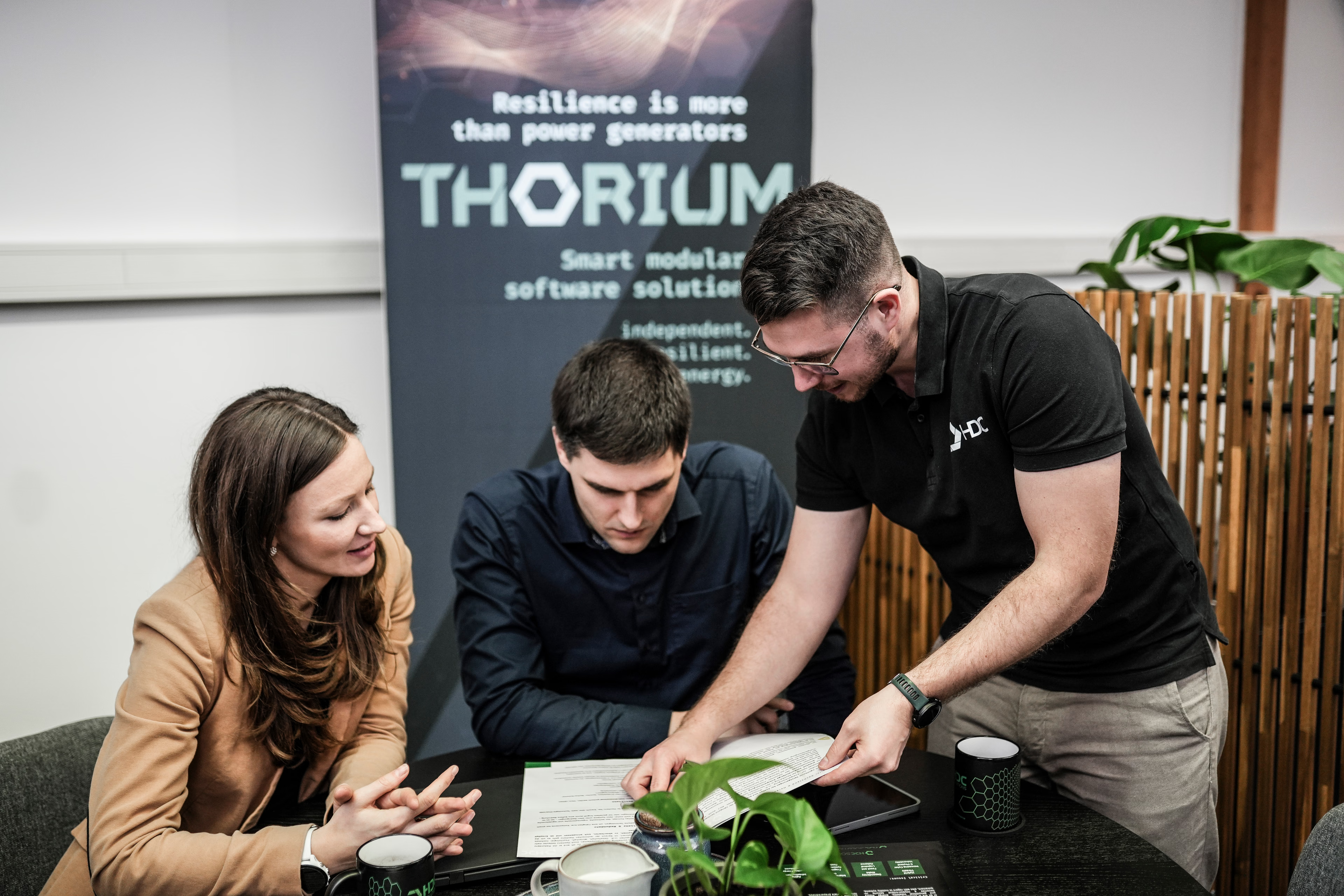
Industry partners
Together with specialized industry partners, we develop and test solutions for specific applications.
DEUTZ Defense
Resilient energy supply for defense applications
HDC Solutions and DEUTZ Defense are jointly developing solutions for energy security in the defense sector. A first result of the collaboration is the GridCube, a deployable energy management system that intelligently connects and controls generators, storage units, and consumers.
Globe Fuel Cell Systems
Fuel cells and H₂ microgrids
In a joint pilot project, Globe Fuel Cell Systems and HDC Solutions are investigating the integration of a fuel cell system into an intralogistics vehicle and its connection to an H₂ microgrid. THORIUM maps energy flows and interactions across the entire system and enables the study of bidirectional energy flows.
Research & Science
HDC works with universities and research institutions on the development, testing, and validation of technologies and methods for energy systems.
University of the Bundeswehr Munich
Research and testing of energy systems
HDC's scientific roots lie at the University of the Bundeswehr Munich. Demonstrators and research infrastructures are available there, where energy systems and new technological approaches can be tested and further developed under realistic conditions.
LEC GmbH
Simulation of complex energy systems
The collaboration with the Large Engines Competence Center forms an important technological foundation for energy system simulation at HDC. THORIUM builds on the LEC ENERsim simulation environment and further develops its approaches for use at HDC.
TU Graz
New methods for simulation, optimization, and resilience
Together with research institutions at TU Graz, HDC is advancing digital optimization and simulation methods for complex energy systems. One focus is on more precisely modeling dynamics and dependencies. With the Christian Doppler Laboratory, for example, research is being conducted on how resilience can be made measurable using physics-driven machine learning. ITNA is also involved in the development of the GridCube.
Esslingen University of Applied Sciences
Making hydrogen combustion more efficient
Together with Esslingen University of Applied Sciences, HDC is working on improving the technical and economic efficiency of hydrogen combustion. One focus is the development and validation of an additively manufactured pre-chamber spark plug. The project is funded by an innovation voucher from the Free State of Bavaria.
Research project
INDY – Energy Independent and Efficient Deployable Military Camps
HDC worked with an international consortium on energy-efficient and independent solutions for deployable military camps.
HDC's focus was on simulating complex energy systems, predictive control strategies, integrating real-time data, and optimizing energy flows.
EU-funded research project